
Metrc Reporting Software: Compliance Without the Spreadsheet Tax
Metrc knows every plant, package, transfer and test result in your operation. It knows nothing about what any of it cost. That gap is why operators automate compliance reporting, keep paying for it, and still rebuild cost of goods sold by hand every month.
Your COGS number is probably wrong.
Not wrong by a rounding error. Wrong in the direction that changes which products you run and what you owe in April. And it isn’t your accountant’s fault. Cost of goods sold in a manufacturing operation needs four inputs: what went into the batch, who worked on it, what the facility cost to run while they did, and how all of that hits the general ledger. Metrc holds one of those four. Your payroll system holds the second. Your accounting system holds the third and fourth. Nobody joins them except a person with an export folder and a deadline.
That person is the spreadsheet tax. Most Metrc reporting software doesn’t remove it. It relocates it.
What Metrc reporting software is asked to do
Metrc is the state-mandated track-and-trace system in about two dozen U.S. states and jurisdictions, serving more than 520,000 users across the supply chain and the agencies regulating it. It exists to prove product moved legally. Plant tags, package tags, harvest records, transfer manifests, lab results, waste. For a manufacturer, it is the most complete physical record of the operation that exists anywhere in the building.
It was never built to be read.
You can see that in the API. Metrc caps GET calls at 50 per second per facility and 150 per second per integrator key, allows 10 concurrent reads per facility, and returns a 429 with a Retry-After header when you go over. Writes get no rate limit at all. PUT, POST and DELETE run unthrottled. That’s a system engineered to receive compliance data quickly and hand it back slowly, which is the correct design for a regulator and the wrong one for a finance team.
So a category grew up in the gap. Software that reads Metrc, stores it, and puts a usable interface on top. Seed-to-sale platforms, cannabis MRPs, compliance suites. They solve a real problem, and every one of them says the same sentence on its homepage: we help you manage your Metrc data. When everybody says it, it stops being a differentiator and starts being table stakes.
Here’s the question worth asking at renewal: what does yours do with Metrc data that a reporting layer wouldn’t?
Where the manual work goes instead
The pitch for a Metrc layer is fewer spreadsheets. For compliance, that’s true. Tag reconciliation, transfer manifests, package adjustments and state reporting get faster and less error-prone, and that’s worth paying for.
Then month-end close starts.
Packages and transfers get exported from Metrc, hours from payroll, the trial balance from accounting. Then a workbook maps production hours to batches, spreads facility overhead across rooms, and lands a cost per unit. It takes days, and it gets rebuilt next month, often by a different person and sometimes with a different method. The compliance manager stopped doing manual work. The controller started.
That trade is worse than it looks, because the controller’s version is the one that has to survive an audit.
Why cost accuracy carries more weight in cannabis
Under Section 280E, most operators can’t deduct ordinary business expenses. Cost of goods sold is the deduction that survives, which turns a cost accounting exercise into the single biggest lever on after-tax cash.
The rules aren’t symmetrical, and the gap favors manufacturers. A dispensary capitalizing under the reseller rules gets landed cost: the invoice price plus getting it to the store. A producer using full absorption under §471-11 can capitalize far more. Direct material and direct labor, plus indirect labor and supervisory wages tied to production, utilities and rent for the production space, repair and maintenance and depreciation on production equipment, indirect materials and supplies, and quality control and inspection.
Two operators with identical revenue and identical real-world margins can post very different federal liabilities purely because one captured its allowable production costs and the other didn’t.
Capturing them requires a documented, consistently applied method. Not a workbook assembled at year end by whoever was available.
The 2026 rescheduling made that harder, not easier. The April final order moved state-licensed medical marijuana to Schedule III and left adult-use in Schedule I, so 280E still applies in full to adult-use activity. Hybrid operators now face an apportionment question with no published Treasury guidance to lean on, and every method on the table depends on knowing which product moved through which channel at what cost. If you can’t produce that from source data, you can’t defend it. This is general information, not tax advice. Confirm your position with your cannabis CPA.
The fix: stop buying a prettier Metrc and start joining it
Metrc can’t calculate your COGS, and it shouldn’t have to. What it can do is supply the physical half of the equation more reliably than anything you’d build yourself, because the state already forces you to keep it accurate. The work is joining it to the other half.
Cannahub is a centralized data warehouse for cannabis operators. It pulls Metrc alongside your POS, accounting, payroll and wholesale systems into one place, models them so the fields agree, and serves the result as reports and dashboards. Your systems of record stay where they are. Nobody changes how they enter data.
For cost accounting specifically:
- Metrc is a first-class input. Packages, transfers, harvests and lab results land on a schedule, not by export, with delta syncs and error monitoring instead of someone remembering to pull a file.
- Labor and the GL land in the same warehouse. Which is what makes an absorbed cost per unit computable rather than estimated.
- The allocation method becomes infrastructure. Defined once, applied every run, and reproducible from source data when someone asks how a number was derived.
- Direct access to your own data. Power BI, SQL, OData or Excel, on our license. No BI seats to buy, and pricing is per system and connector rather than per user.
- Clean data first, then reports, then AI. Pointing a language model at raw exports from four systems produces confident answers built on mismatched fields. Pointing it at modeled data doesn’t.
The goal isn’t a better Metrc screen. It’s a cost per unit you can defend.
What it looks like
Here’s a batch-level cost build for a manufacturer. Materials come from Metrc packages, labor from payroll hours mapped to production, overhead from the GL allocated on a documented driver.
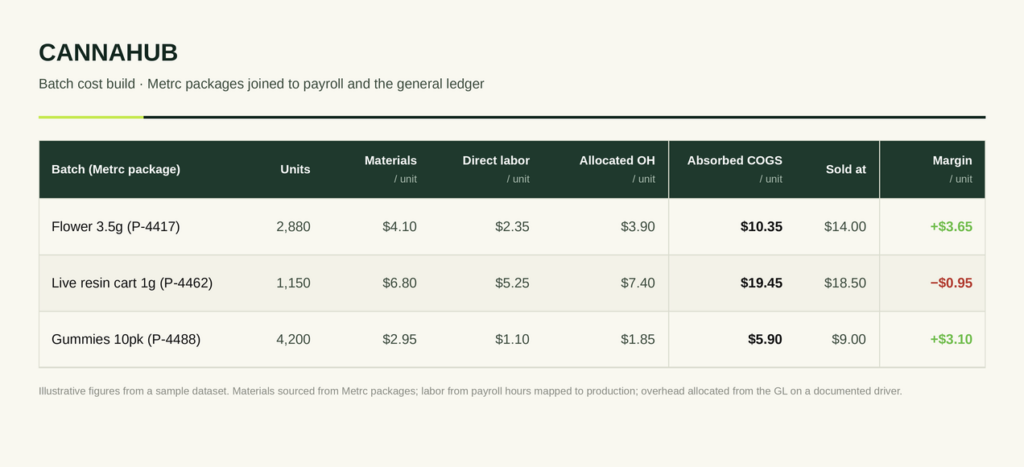
Read the cart row twice. On materials alone it’s the best product in the building: $6.80 of input against $18.50 of revenue. That’s the view a Metrc-sourced report gives you, because materials are the only cost Metrc knows about. Add the extraction technician’s hours, the supervisory time, the utilities on the extraction suite, the depreciation on the equipment and the QC panel, and the product loses money on every unit sold.
Now the part that costs real cash. That cart carries $12.65 per unit of labor and overhead, about $14,500 across the batch. Capitalized into inventory, those dollars come back as COGS. Left sitting in operating expense, under 280E they aren’t deductible at all. Same dollars, same work, two different tax outcomes, decided by whether you could trace them to a batch.
The fair objection: allocation is judgment, not arithmetic. Correct. Square footage, labor hours and machine hours are all defensible drivers, and they produce different answers. Which is why the method matters more than the number. Pick a driver, document it, apply it the same way every period, and make it reproducible from source data. A spreadsheet rebuilt each quarter by a different person is not a method.
The same number at each altitude
If you’re the CFO or controller, absorbed cost per unit is where time savings, cost savings and headcount decisions converge. It tells you which SKUs to stop running, it’s the documented basis your 280E position rests on, and it frees your finance team from three days of assembly work every close for something that moves the business.
If you’re running production or purchasing, it answers a more immediate question. What’s worth the line time this week, what should come off the schedule, and which batch looked profitable right up until the labor landed on it.
Same number, different altitude. Which is the argument for computing it once, correctly, for everyone.
Frequently asked questions
Any tool that reads data out of Metrc and turns it into something usable: compliance reports, inventory views, dashboards. Metrc’s own interface is built for regulatory entry and lookup, so most operators run something on top of it. The category runs from compliance-focused seed-to-sale platforms to full data warehouses.
No, and it was never designed to. Metrc tracks chain of custody. It holds no labor rates, no utility bills, no GL accounts and no vendor invoices. It can tell you a package existed, what it weighed and where it went. It can’t tell you what it cost to make.
Different jobs. An ERP or MRP is where your team enters and executes work: production orders, receiving, inventory moves. Reporting and cost accounting sit on top and read from everything, including the ERP. The question worth asking isn’t which one to have. It’s whether you’re paying twice for the same Metrc data and still getting COGS in a spreadsheet.
Under full absorption, direct material and direct labor plus indirect production costs: supervisory wages tied to production, utilities and rent on the production space, repair and maintenance and depreciation on production equipment, indirect materials and supplies, and quality control and inspection. Resellers are limited to landed cost. Confirm specifics with your cannabis CPA.
They measure different things at different grain. Metrc counts packages and grams on the compliance calendar. Accounting counts dollars and units on the financial calendar. Without a mapping that ties package to SKU to GL account, the two won’t reconcile on their own, and that mapping usually lives in one analyst’s head.
Nightly covers most reporting. The initial historical sync takes roughly 48 hours and first reports typically go live around week three. Cadence matters less than whether the sync is scheduled and monitored. A report nobody trusts is a report nobody uses.
The takeaway
Metrc is not the problem, and it isn’t going to become an ERP. It’s a compliance record you’re already required to keep accurate, which makes it the most reliable production data in your operation and the cheapest thing you already own.
The problem is that reading it isn’t the same as using it. A layer that makes Metrc legible solves a compliance problem and leaves a finance problem untouched, and the finance problem is the expensive one. Joining Metrc to payroll and the general ledger is what turns a compliance obligation into a cost per unit you can act on and defend. That’s not a better view of Metrc. That’s the rest of the equation.